
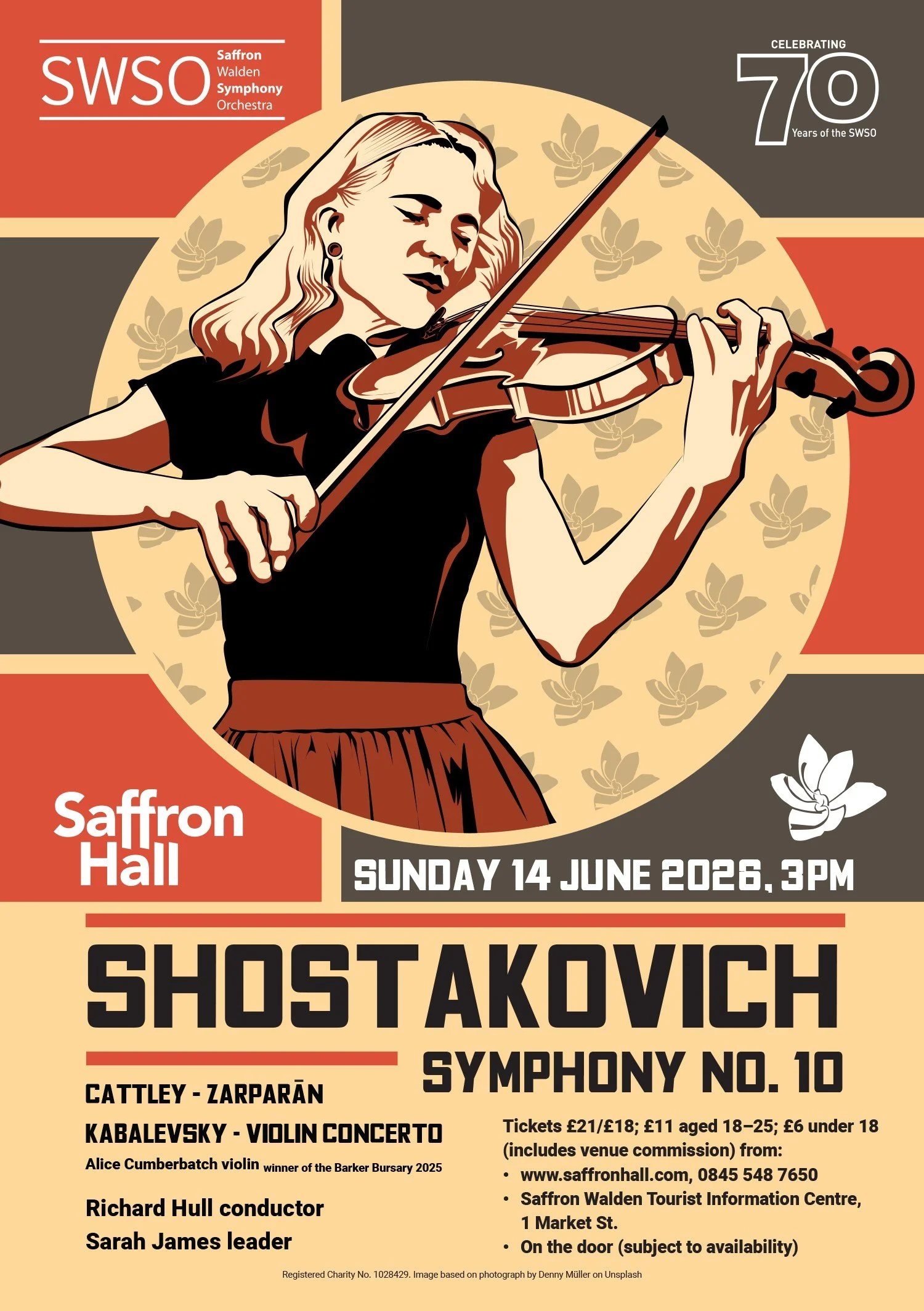
Saffron Walden Symphony Orchestra 70th Anniversary Concert
Sunday June 14th 2026
Over the 70 years of its history being celebrated this year the Saffron Walden Symphony Orchestra, originally called the Uttlesforde Orchestra, has built a reputation for excellent performances featuring works or performances by up-and-coming young musicians. On Sunday 14th they achieved both, as well as successfully tackling one of the most formidable challenges in the repertoire – Shostakovich’s 10th Symphony.
Opening the concert was the imaginatively titled ‘Zarparan’ by Sarah Cattley, following in the footsteps of her award-winning mother, Uttlesford-based composer Janet Wheeler. The title is the Persian word from which we derive the word ‘Saffron’ and means ‘gold strung,’ conjuring an image of gold-strung instruments such as harps and violins – both featuring prominently in the work. An immaculately accomplished opening in the strings was followed by a lively dancelike passage, then a quieter interlude including the occasional jazz reference. After a return to the dance a subdued passage featured beautifully played oboe and piccolo solos and the piece concluded with an energetic contribution from the brass team. This world premier was received with great enthusiasm by the audience.
The highlight of the concert was a dazzling performance of the Violin Concerto by Dmitry Kabalevsky, given by the 12 year old Alice Cumberbatch. Displaying stage presence, technical assurance and musicality well beyond her years Alice tackled the work’s challenges with crisp execution and attention to nuance, bringing out the essence of the more soulful, folk-melody based passages. Her nimble account of the third movement’s first subject was beautifully contrasted with the lyrical theme which followed. The more demanding double-stopping passages were accomplished with verve and conviction, as was the cadenza which followed. Her instrument gave a full and rich tone in its lower register which she exploited to the full. The performance was greeted with richly deserved and prolonged applause. Now studying at the Menuhin School, here is a young artist of whom we will undoubtedly hear more in future.
The second half of the concert consisted of Shostakovich’s mighty 10th Symphony. The orchestra met its challenge with courage and determination, achieving an admirable continuity in what could easily become a disjointed account. Especially noteworthy were the solo woodwind passages, admirably coping with the composer’s habit of leaving the instrumentalist exposed without accompaniment through extended passages. Prominent episodes in the french horns were accomplished with impressive conviction and unanimity, whilst exposed passages in the violins and violas called forth notable ensemble and control. A fierce attack opening the second movement brought out the power and drama of Shostakovich’s writing, followed by some excellent pianissimi in the strings. Tight string ensemble continued in the third movement which also featured some incisive flute and woodwind work. The somewhat fragmented structure of the fourth movement never lost its coherence and continuity, with well calibrated contrasts between the full orchestra and quieter episodes.
The entire concert fully deserved the enthusiastic applause with which the audience greeted it. It was however regrettable that these were somewhat sparse in number. Perhaps this might be remedied by programming to include at least one ‘crowd-puller’ as, for all their importance in the repertoire, none of these works is well known to a general audience. Nevertheless the orchestra is to be commended for rising so magnificently to the challenges placed before it by their adventurous conductor Richard Hull. May their next 70 years be as successful as those to date.
Ian Priest
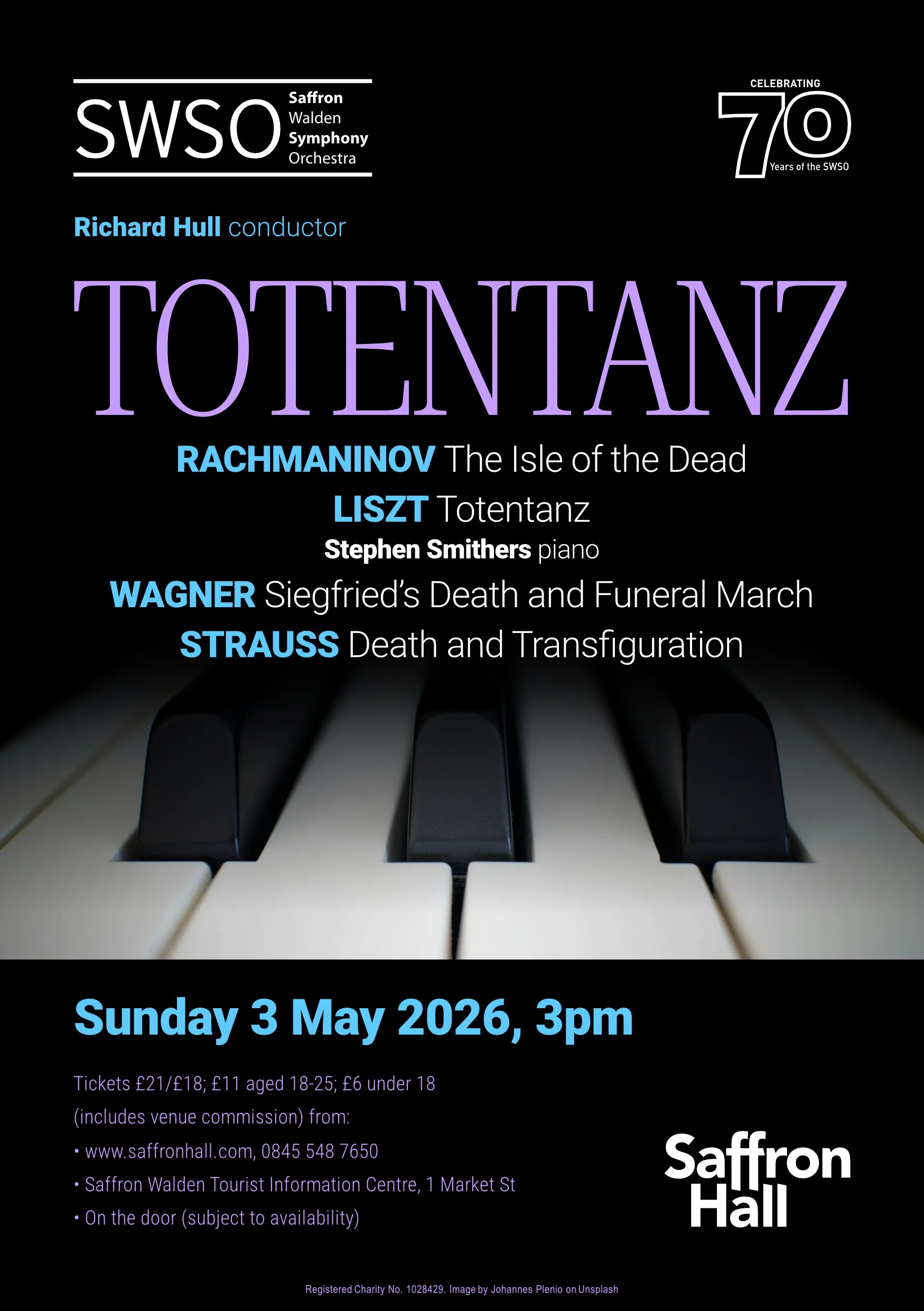
Saffron Walden Symphony Orchestra Concert
Sunday 3 May2026
Concert goers and fans of the incomparable asset that is Saffron Hall were treated to a virtuoso performance at Sunday afternoon’s concert by the Saffron Walden Symphony Orchestra, this year celebrating the 70th anniversary of their foundation in 1956 as the Uttlesforde Orchestra. Beginning with Rachmaninov’s tone poem, The Isle of the Dead opens quietly in 5/8 rhythm growing gradually with some fine playing by the six french horns followed by a section played with impressive unanimity by the cellos. The music reached a peak with full orchestra dominated by a powerful brass section, before subsiding into fragments of the mediaeval plainchant Dies Irae – Day of Wrath, a recurrent theme in Rachmaninov’s compositions.
The highlight of the concert was undoubtedly the dazzling performance of Franz Liszt’s ‘Totentanz’ by the young and gifted Bishop’s Stortford virtuoso pianist Stephen Smithers. Stephen first appeared with this orchestra as a teenager and has joined them as soloist many times since. Liszt’s composition is a series of variations on the ‘Dies Irae’ theme, featuring piano solo passages accomplished with spectacular dexterity and force, from the opening solo passage to the furious fugue, all in the minor key, before returning to the theme in a more joyous major key and then into a piano cadenza of demonic intensity before the music calms into a delicate passage that features the gentle tinkle of Liszt’s favourite percussion instrument, the triangle. The piece proceeds by way of two further exhilarating piano cadenzas, with a rippling chromatic feature in the right hand over the main theme in the left, before the rousing final bars. The dexterity and confident professionalism with which Stephen accomplished this most taxing of piano works earned him prolonged, enthusiastic and richly deserved applause from an exhilarated audience.
The second half of the concert consisted of two reflections on the theme of death and transfiguration: Wagner’s Funeral March from his opera ‘Siegfried’, of which Wagner himself said “never again will I write anything as complicated as that”; followed by Richard Strauss’s meditation on the same theme from which he takes his title. Strauss follows the physical and mental tribulations of the dying artist, portrayed in dialogues between the different instruments of the orchestra and rising to a radiant climax before subsiding almost to silence as the artist’s spiritual journey reaches its end.
The Orchestra was expertly led through these challenging works by their conductor Richard Hull, and displayed the wide variety of its technical expertise in all sections whilst presenting an accomplished and satisfying whole. We are fortunate indeed to have such musicianship flourishing in our midst and wish them well for their anniversary, in anticipation of their performances through the decades to come. They richly deserve the privilege of appearing regularly in this magnificent concert venue.
Ian Priest